
Packaging Watch | September 2026
Three Packaging Changes Worth Knowing About and Why
Packaging Watch is an occasional PackagingChic series that looks beyond the headlines to explain what packaging changes really mean for brands and the people responsible for getting products to market.
Not every update in this month's Packaging Watch affects every industry. My goal is to highlight changes that are worth knowing about, even if they only apply to certain types of products.
Something here sound familiar?
If one of these issues is showing up in your own packaging project, let’s take a look at it together. Sometimes a short conversation can clarify what to ask, what to check, and what to do next. Schedule a Discovery Call
Packaging news can get complicated fast. A mill announces a price increase. Someone says board is “tight.” A printer introduces a new security feature.
But what does any of that actually mean if you’re buying packaging?
Here are three things I’m watching this month.
Containerboard Prices Are Going Up — But It’s Not That Simple
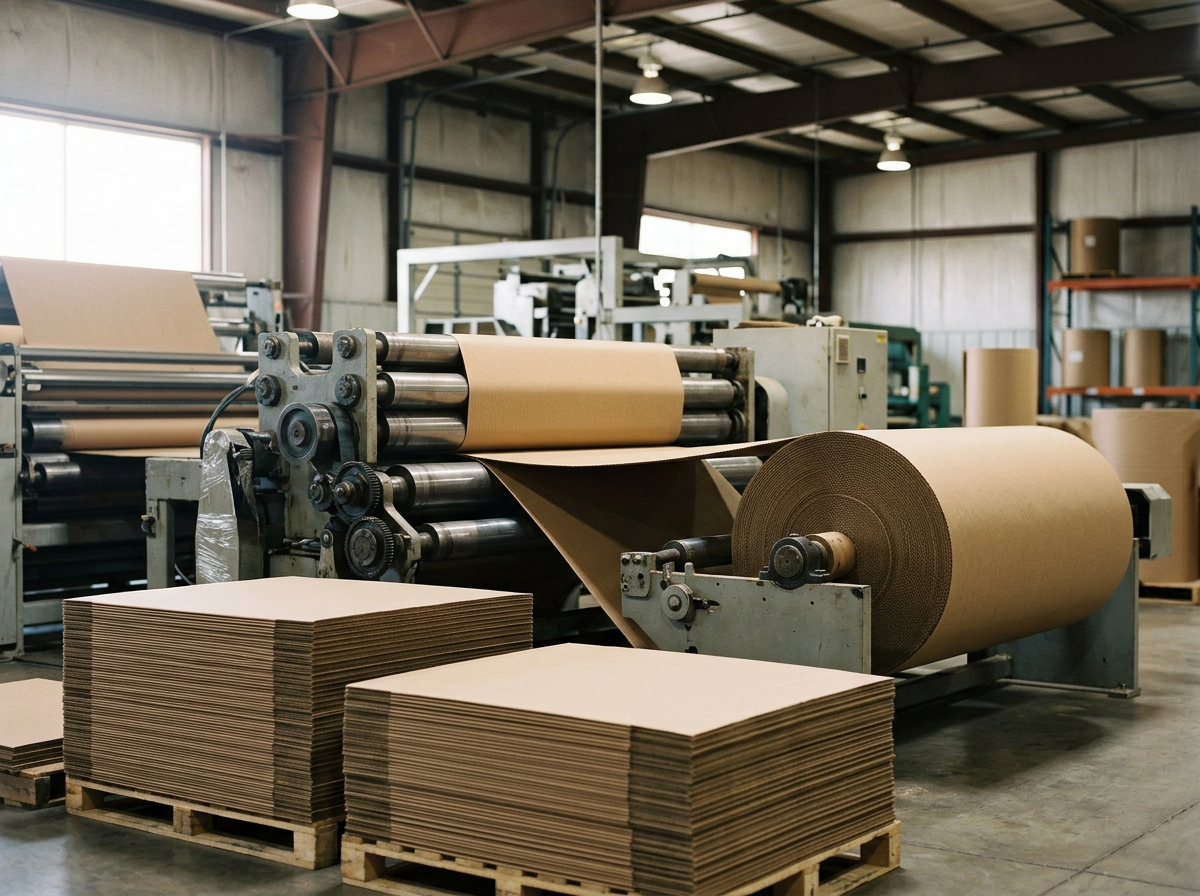
Several large U.S. containerboard producers announced September price increases. Packaging Corporation of America announced $140 per ton, Smurfit Westrock $100 per ton, and International Paper $80 per ton.
But that doesn’t mean the price of your corrugated box automatically goes up by the same amount.
The PackagingChic translation
Containerboard is the material used to make corrugated board. It includes the flat linerboard on the outside and the fluted medium in the middle. When a mill announces an increase, that increase still has to work its way through the market.
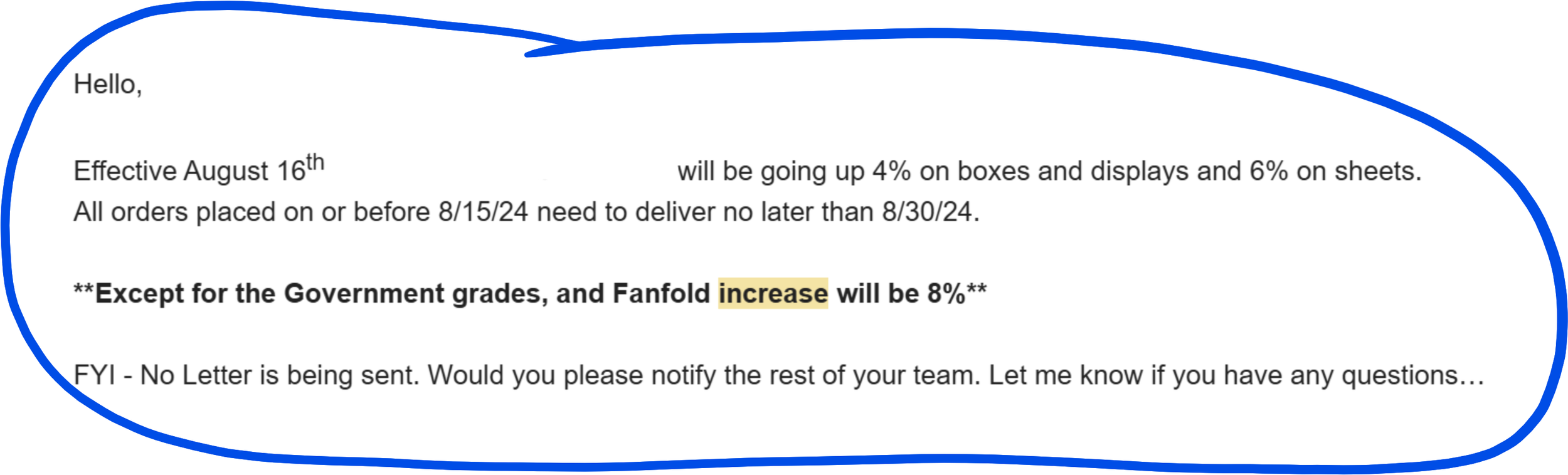
A converter may end up paying all of it, part of it, or seeing the change at a different time depending on its suppliers, contracts and inventory. They also may or may not pass it on to their customers right then. Eventually, some of that higher cost can show up in your box price.
So if your corrugated supplier says, “Paper pricing went up,” it’s fair to ask a little more:
Which increase? When did it hit your cost?
And how much of my increase is actually coming from containerboard?
That’s especially useful when you’re comparing quotes from different suppliers. Most of the time suppliers will send out an email about future price increases that will show up in estimates. Oftentimes the email will have a date to order by to avoid the increase!
SBS Is Getting More Expensive — What Is FBB and Is It an Alternative?
Moving from the corrugated world to the folding carton world . . .
SBS prices increased again in August, and domestic lead times have been reported at roughly 11–14 weeks in some cases.
SBS — solid bleached sulfate — is a familiar, very common choice for high-quality folding cartons, especially when appearance and print quality matter. But SBS is not the only option.
Have you heard of FBB? FBB stands for folding boxboard. Clever name, ha!
Unlike SBS, which is made from bleached fiber throughout the sheet, FBB is a multi-layer board with different fibers in the inner and outer layers. That construction gives FBB more bulk and stiffness at a lighter weight, while SBS is known for its smooth, bright white surface and consistent print quality.
Depending on the package, FBB can be an interesting alternative. But it isn’t necessarily a one-for-one substitute for SBS.
But this is exactly why saying “paperboard is tight” doesn’t tell us enough.
Different grades come from different mills, have different supply situations and behave differently when they are printed, scored and folded.
The PackagingChic translation
If your usual SBS is expensive or taking too long to get, a supplier may suggest FBB or another board grade.
That may be a perfectly good solution. But make sure it still works for the package. The look can be different. The stiffness can be different. Printing, scoring and folding can be different.
A board substitution should be a packaging decision, not simply a purchasing decision.
For an upcoming folding-carton project, I would want to know the exact board grade and current lead time early — before the artwork is finished and the production date is locked.
Of course, all of this lead time stuff depends on your supplier partner. Many box companies keep board on the floor in specific sizes and then cut it down to sheets so that they can run your job economically. This works for shorter runs and only if that company works in this way.
For large brands and projects, all of the timelines, board type and availability really matters!
Invisible Security Built Into the Carton? Tell me more!

Image courtesy of Koenig & Bauer
Curtis Packaging announced that it is now the first U.S. printer certified to offer Koenig & Bauer's cp³ — Certified Protected Print Provider — technology for luxury packaging.
And this is not another security sticker, hologram or visible QR code added to the box.
Information such as codes, images or logos can be hidden directly within the printed artwork or the varnish. The feature is created as part of the prepress and printing process and is designed to be invisible to the eye. Even under strong magnification. A smartphone app can then read the hidden information and help verify that the package or product is authentic.
Think of it as information hiding inside the print rather than sitting on top of it. That's especially attractive for luxury packaging, where nobody really wants an authentication feature interfering with a carefully designed carton.
A little background on Koenig & Bauer: they're a German printing technology company founded in 1817 and the world's oldest printing press manufacturer. Their equipment is used for everything from folding cartons and corrugated packaging to banknotes and other security printing. So the idea of bringing security-printing technology into branded packaging isn't quite as far a leap as it first sounds.
The PackagingChic translation
What caught my attention here is that the security feature becomes part of something the package is already doing: printing.
There doesn't have to be another label, tag or obvious device competing with the graphics. For a beauty, fragrance, spirits or other premium brand that has spent quite a bit of time getting every square inch of the carton just right, that's a meaningful advantage.
Koenig & Bauer calls the underlying approach steganographic technology. In simple terms, information is hidden inside another image or printed layer so that you don't normally see it. Their system can place that information within the printed image itself or within the varnish. Standard inks can be used, according to Koenig & Bauer, which also makes the technology easier to integrate into an existing printing process. I would love to see this in action!
Packaging has always carried information we can see: the brand, ingredients, instructions, barcodes, regulatory copy and all of those other things fighting politely for real estate on the carton. Now it can carry information we can't see too.
For brands dealing with counterfeiting, diversion or questions about product authenticity, that opens up some interesting possibilities.
But it also brings us back to an important packaging question:
What are we actually trying to protect against?
Authentication, counterfeit protection, serialization and tracking aren't necessarily all the same problem.
Is the goal simply to let someone confirm, Yes, this is a genuine product?
Do you need to identify individual packages?
Do you need to know where a product has traveled through the supply chain?
Or are you trying to make the package itself much harder to reproduce?
Those answers lead to very different solutions. Before adding security technology to packaging, define the problem first. Then choose the technology.
What I’d check this month
If any of these developments touch your packaging, here are a few practical things I’d be asking:
If you buy corrugated packaging, look at any recent price increase notices from your supplier. Ask what increase is behind the change, when it affects their costs, and whether there is an order-by date that could help you avoid or delay the increase.
If you have folding cartons coming up, confirm the exact paperboard grade and current lead time early in the project. If your supplier recommends FBB or another substitute for SBS, make sure you understand how the change could affect stiffness, printing, scoring and folding before approving it.
If counterfeit protection or product authentication is becoming important to your brand, define what you actually need the packaging to do before choosing a technology. Do you simply need to verify that the product is genuine? Identify each package? Track it through the supply chain? Or make the package harder to reproduce?
Sharon’s Take
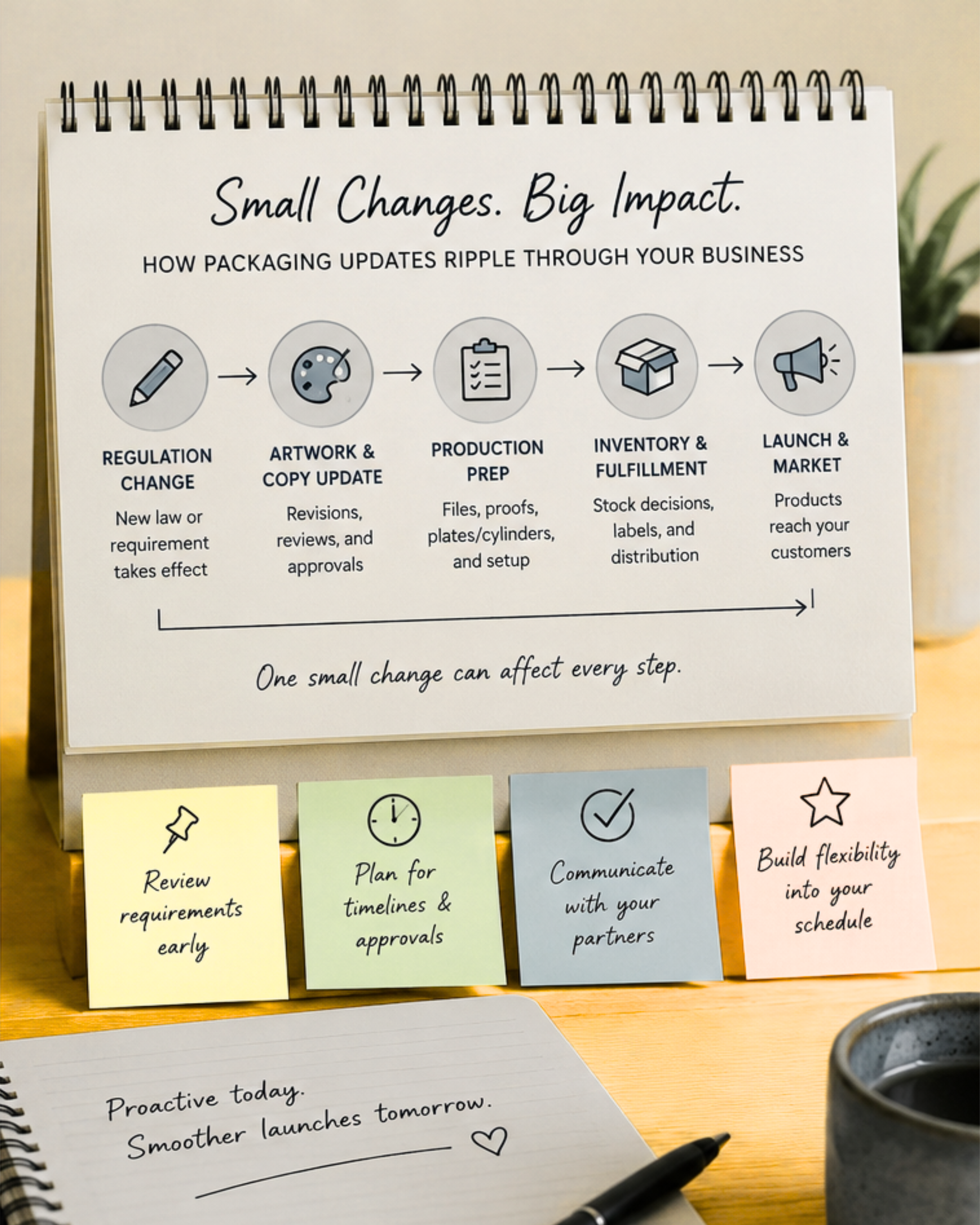
These are three very different packaging developments, and that is exactly what Packaging Watch is meant to cover.
This month it happens to be pricing, paperboard availability and new security technology. Another month it may be regulations, production, materials or something else entirely.
The goal is not just to tell you what happened.
It is to explain enough of the packaging behind the headline that you can ask better questions when it affects one of your own projects.
Packaging Watch is my look at changes in materials, manufacturing, pricing, regulations and other packaging details that may affect the brands producing packaging every day.
References
More info on paperboard/containerboard pricing: 3 Paper Packaging CEO’s talk market volatility
Ever wonder how the price increases seem to crop up across the industry all at once? So do others! There’s a lawsuit for that.
