
Packaging Watch | July 2026

Three States. One Effective Date. Here's Why It Matters.
Packaging Watch is an occasional PackagingChic series that looks beyond the headlines to explain what packaging changes really mean for brands and the people responsible for getting products to market.
Not every update in this month's Packaging Watch affects every industry. My goal is to highlight changes that are worth knowing about, even if they only apply to certain types of products.
I was catching up on packaging news over the July 4th weekend—not exactly beach reading, I know—when something caught my attention.
Three different packaging-related laws all took effect on July 1.
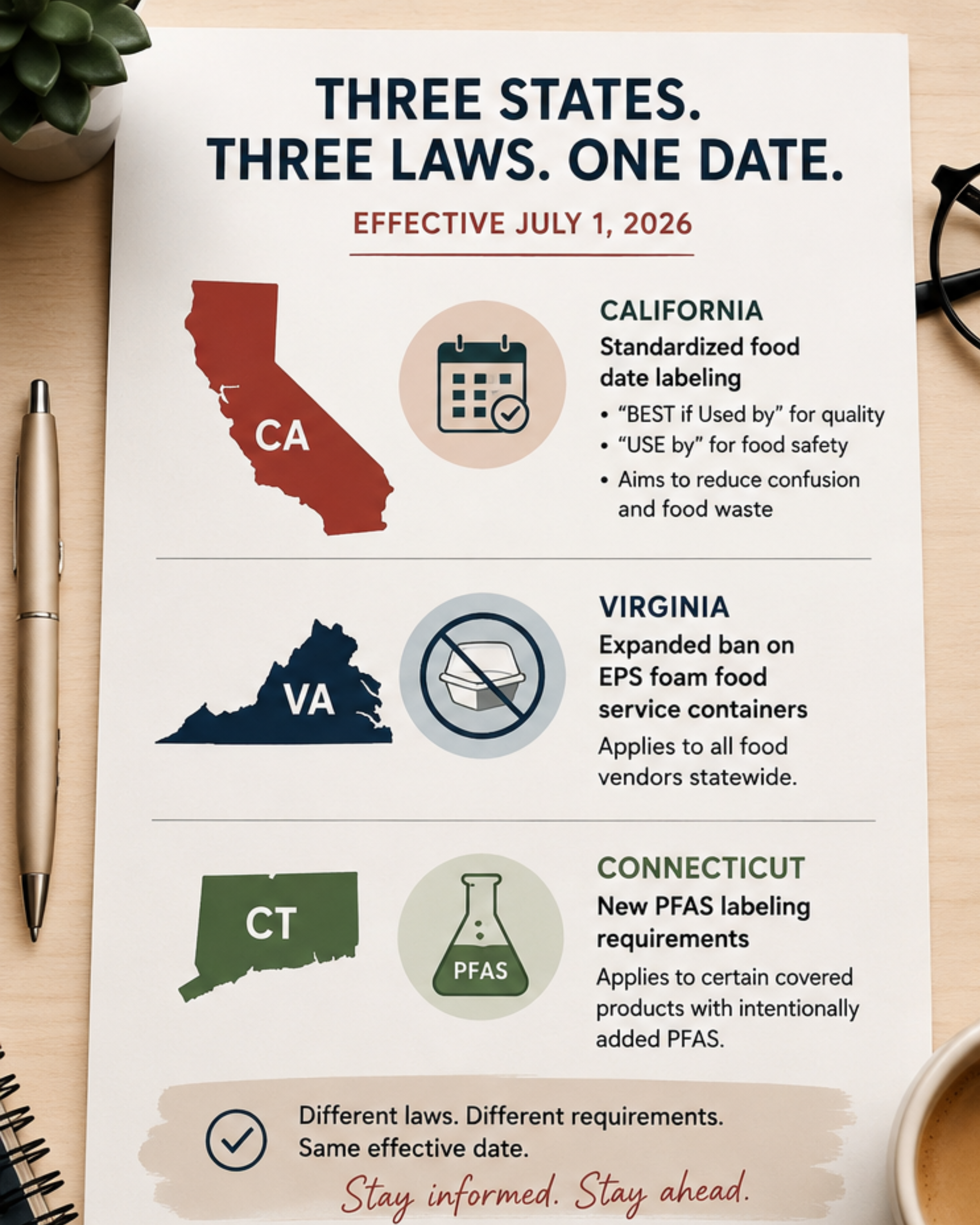
On their own, none of them seemed especially dramatic. California standardized date labeling for packaged foods sold in the state. Virginia expanded its ban on expanded polystyrene (EPS) foam food service containers. Connecticut introduced new PFAS labeling requirements for certain products.
Three different states. Three different laws. One effective date.
If your company sells nationally, that's more than an interesting coincidence. It's a reminder that packaging compliance rarely arrives one change at a time.
What changed?
Here's the short version.
California now requires standardized food date labels for most packaged foods sold in the state. Consumer-facing phrases like "sell by" are being replaced with clearer language such as "BEST if Used by" for product quality and "USE by" for food safety. The law is intended to reduce consumer confusion and help decrease food waste.¹
Virginia expanded its existing ban on EPS foam food service containers. As of July 1, the law now applies to all food vendors throughout the state.²
Connecticut has added new PFAS labeling requirements for certain covered products that contain intentionally added PFAS. The requirements apply to specific product categories rather than all packaging, but they add another compliance checkpoint for affected manufacturers.³
None of these changes are directly related. They simply landed on the same day.
Why this matters
When people hear "label update," it often sounds like a simple wording change. In production, it rarely is.
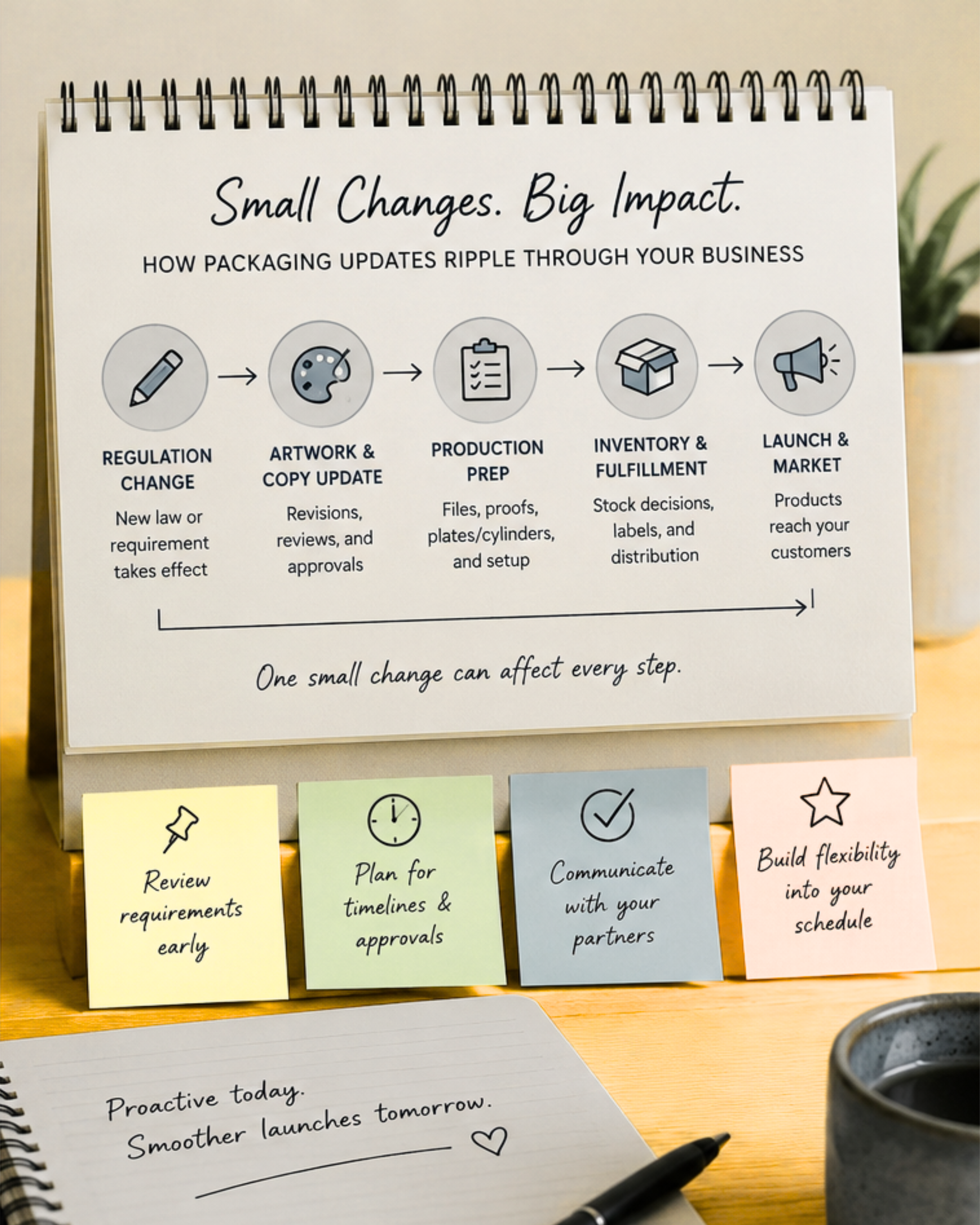
Even a small packaging revision can trigger artwork updates, regulatory review, proof approvals, file management, inventory decisions, and production scheduling. Depending on how the package is printed, it may also require new plates, cylinders, or updated digital press files.
Now imagine managing dozens—or hundreds—of SKUs across multiple states, each with different requirements and different timelines.
The challenge isn't understanding the regulation. It's coordinating everything that happens because of it.
Looking beyond the headlines
This isn't really a story about California, Virginia, or Connecticut. It's a story about how packaging changes tend to arrive.
Regulations, supplier updates, sustainability initiatives, customer requests, and product launches rarely wait their turn. They overlap. Each one may be manageable on its own, but together they compete for the same resources, the same artwork files, and the same production schedule.
That's why a seemingly minor change can suddenly become the project everyone is talking about.
What I’d check this month
If your products are affected by any of these recent changes, here are a few practical steps worth taking:
Review your product lineup to determine whether California's new food date labeling requirements apply to any of your SKUs.
If you sell food products in Virginia, confirm that your food service packaging complies with the expanded EPS foam restrictions.
If your products fall within Connecticut's PFAS requirements, verify whether any labeling or reporting obligations apply.
If you sell internationally, review upcoming compliance deadlines for the markets you serve. The European Union's Packaging and Packaging Waste Regulation (PPWR) becomes applicable on August 12, 2026, making this a good time to confirm that documentation and implementation plans are on track.⁴
Sharon’s Take
Packaging projects rarely get derailed by a single big event.
More often, it's a series of smaller changes that all need attention at the same time.
A new regulation. A revised specification. A customer request. An unexpected production delay.
Individually, none of them feels overwhelming. Together, they can put real pressure on a packaging schedule.
That's one reason I encourage regular packaging reviews instead of waiting until a project is already in production. Catching a change early usually costs far less—in time, money, and stress—than discovering it after artwork has been approved or materials have been ordered.
References
California Department of Food and Agriculture. Food Date Labeling (AB 660). Effective July 1, 2026.
Virginia Department of Environmental Quality. Expanded Polystyrene (EPS) Foam Food Service Container Ban. Effective July 1, 2026.
Connecticut Department of Energy & Environmental Protection. PFAS in Products Program.
European Union. Packaging and Packaging Waste Regulation (PPWR). Regulation (EU) 2025/40. Applicable beginning August 12, 2026.
